
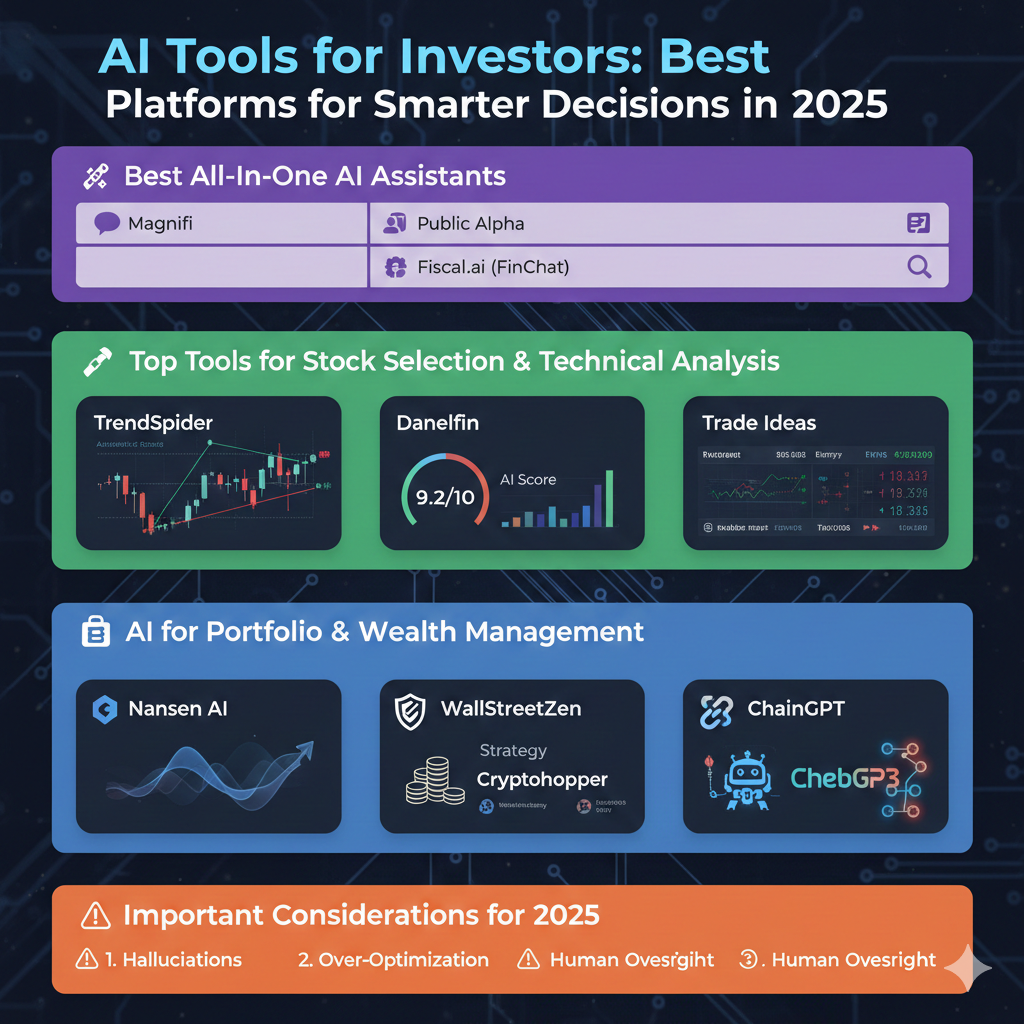
Artificial intelligence has fundamentally changed how investment decisions are made.
In 2026, investors no longer rely solely on charts, static ratios, or analyst opinions. AI tools for investors can now process massive datasets in seconds, detect hidden patterns, analyze sentiment across millions of sources, and help reduce emotional decision-making.
What once required teams of analysts is now accessible to individual investors through the right AI-powered platforms.
Whether you’re a retail investor building your first portfolio or an experienced trader managing complex strategies, the right AI tools can dramatically improve how you analyze markets, manage risk, and allocate capital.
This guide covers the best AI tools for investors in 2026, how they work, who they are for, and how to choose the right platform based on your investing style.
Table of Contents
What Are AI Tools for Investors?
AI tools for investors are platforms that use technologies such as machine learning (ML), natural language processing (NLP), and predictive analytics to support investment decisions.
Instead of manually reviewing:
- earnings reports
- macroeconomic data
- price charts
- news headlines
AI systems analyze this information automatically and convert it into insights investors can act on.
In practice, AI tools help investors:
- screen stocks more efficiently
- detect trends earlier
- analyze risk and volatility
- process earnings calls and news instantly
- optimize portfolios
The goal of AI in investing is not to replace humans, but to augment decision-making with speed, scale, and objectivity.
How AI Is Changing Investment Decision-Making in 2026
Traditional investing relied heavily on historical data and human interpretation. AI changes the game in several key ways:
1. Real-Time Data Processing
AI tools for investors continuously scan markets, news, filings, and sentiment data in real time, allowing investors to react faster than ever.
2. Analysis of Unstructured Data
Unlike traditional models, AI can analyze:
- earnings call transcripts
- news articles
- social media sentiment
- macroeconomic commentary
This provides a broader picture of market psychology.
3. Adaptive Models
Modern AI systems learn over time. As new data enters the system, models adjust and improve, making insights more relevant in changing market conditions.
As a result, AI is now used not only by hedge funds and institutions, but increasingly by retail investors, narrowing the information gap.
AI Tools for Retail Investors vs Professional Investors
Not all AI tools are built for the same audience.
AI Tools for Retail Investors
These platforms focus on:
- ease of use
- clear, actionable insights
- education and context
- portfolio-level guidance
They are ideal for investors who want better decisions without heavy technical complexity.
AI Platforms for Professional & Hedge Fund Strategies
More advanced platforms provide:
- alternative data
- macroeconomic modeling
- quantitative signals
- backtesting and automation
- API access
These tools offer deeper analytical power but require more experience and technical knowledge.
AI Tools for Stock Analysis & Investment Insights
These platforms help investors analyze companies, fundamentals, and market trends.
Trade Ideas — Smart Stock Scanning and Alerts
Trade Ideas is one of the most advanced AI platforms for active traders. Its AI engine, “Holly,” analyzes millions of data points daily to generate trading opportunities.
Key benefits:
- AI-generated buy and sell signals
- continuous backtesting
- adapts daily to market conditions
Best suited for short-term traders and swing strategies.
Zacks Investment Research — Predictive Analytics at Scale
Zacks uses an AI-powered ranking system that analyzes earnings revisions, analyst sentiment, and financial data.
Why it works:
- proven historical outperformance
- combines machine learning with human research
- trusted by retail and institutional investors
Finchat — AI-Powered Stock Research Assistant
Often described as “ChatGPT for finance,” Finchat allows investors to ask natural-language questions and receive data-backed answers instantly.
Best for:
- fast due diligence
- company comparisons
- skipping manual data digging
(Related: How AI Is Transforming Personal Finance in 2025)
AI Platforms for Portfolio Management & Risk Analysis
These tools focus on portfolio-level decisions, not just individual stocks.
Kavout — Machine Learning Stock Ratings
Kavout’s AI engine analyzes fundamentals, technicals, and sentiment to assign predictive “K Scores” to stocks.
Why investors use it:
- combines multiple data dimensions
- updated continuously
- integrates with broker dashboards
YCharts — Data Visualization Meets Intelligence
YCharts combines AI insights with advanced visualization tools.
Best for:
- portfolio comparison
- macroeconomic analysis
- advisor-level reporting
AI Trading & Quantitative Platforms
Designed for investors who want automation or advanced execution.
Alpaca — Algorithmic Trading for Everyone
Alpaca provides AI-friendly trading APIs that allow investors to automate strategies.
Features include:
- commission-free trading
- backtesting and risk controls
- integrations with Python and AI tools
Numerai — Crowd-Sourced AI Hedge Fund
Numerai uses thousands of machine-learning models built by global data scientists to power a hedge-fund-style strategy.
Unique aspects:
- encrypted data sets
- performance-based incentives
- blend of AI, finance, and crypto
AI Tools for Macroeconomic & Market Analysis
Macroeconomic trends strongly influence long-term investing decisions.
Bloomberg Terminal — Institutional-Grade Intelligence
Bloomberg remains the gold standard for professional investors, with AI integrated across news, analytics, and forecasting.
Why it dominates:
- unmatched global data coverage
- AI-powered summaries
- real-time macro and market intelligence
Sentifi — AI-Driven Market Sentiment
Sentifi analyzes millions of news articles, social posts, and reports to detect sentiment shifts.
Best for:
- identifying emerging risks
- tracking institutional behavior
- understanding why markets move
Benefits of Using AI Tools for Investors
AI tools for investors offer several advantages:
- faster analysis
- reduced emotional bias
- improved consistency
- better risk awareness
- access to institutional-style insights
For many investors, AI acts as a second brain, filtering noise and highlighting what matters most.
Limitations and Risks of AI Investing Tools
AI is powerful, but not perfect.
Key limitations:
- models rely on historical data
- black-box decision-making
- risk of overconfidence
- poor results if misunderstood
AI tools should support decisions, not replace judgment.
How to Choose the Right AI Tool for Your Investing Style
Ask yourself:
- Am I a long-term investor or an active trader?
- Do I want insights or automation?
- How technical am I comfortable being?
- Do I focus on stocks, macro trends, or portfolios?
Simple guideline:
- beginners → insight-driven platforms
- intermediate investors → screening and portfolio tools
- advanced users → quant and trading platforms
How AI Fits Into a Beginner Investing Strategy
AI tools work best when combined with:
- disciplined budgeting
- emergency savings
- a long-term mindset
Technology improves decisions, but it does not remove the need for strong financial foundations.
👉 Pair this guide with:
How to Invest in Stocks With $100 (Beginner’s Guide for 2025)
Common Mistakes When Using AI Tools for Investing
- blindly following AI signals
- overtrading due to false confidence
- ignoring risk management
- using tools you don’t fully understand
The goal is clarity and consistency, not complexity.
AI Tools for Different Investor Profiles
Not every investor uses AI tools in the same way. The effectiveness of AI-powered platforms depends heavily on your experience level, goals, and risk tolerance.
AI Tools for Beginner Investors
For beginners, the main value of AI tools lies in clarity and education, not automation.
Beginner-friendly AI platforms typically:
- explain investment insights in plain language
- highlight risks clearly
- avoid excessive technical indicators
- focus on long-term fundamentals
These tools help new investors build confidence, understand markets, and avoid emotional mistakes during volatility.
AI Tools for Long-Term Investors
Long-term investors use AI primarily for:
- fundamental analysis
- macroeconomic trend detection
- portfolio diversification
- risk monitoring
AI helps identify companies with strong financial health, track valuation changes, and understand how economic shifts impact long-term performance.
Rather than chasing short-term signals, long-term investors use AI to support disciplined decision-making.
AI Tools for Active Traders
Active traders and swing traders rely on AI tools differently.
Their priorities include:
- real-time alerts
- technical pattern recognition
- volatility analysis
- fast execution support
AI-powered scanners and trading platforms allow traders to react faster, test strategies, and manage risk more efficiently than manual methods.
How AI Tools Improve Risk Management
One of the most underestimated benefits of AI tools for investors is risk management.
AI systems help investors:
- detect abnormal market behavior
- identify correlations between assets
- monitor drawdowns and volatility
- stress-test portfolios under different scenarios
Instead of reacting after losses occur, AI allows investors to anticipate potential risks and adjust exposure proactively.
This is especially valuable during periods of market uncertainty, inflation shocks, or geopolitical events.
AI Tools and Behavioral Investing
Many investment mistakes are driven by emotions, not lack of information.
AI tools help reduce:
- fear during market downturns
- greed during rallies
- overconfidence after wins
- panic selling
By relying on data-driven insights rather than emotions, investors can maintain consistency and discipline over time.
AI doesn’t eliminate emotions — but it creates a buffer between emotion and action.
Are AI Tools Worth the Cost?
Some AI investing platforms are free, while others can cost hundreds or even thousands of dollars per year.
Whether an AI tool is “worth it” depends on:
- portfolio size
- investing frequency
- decision complexity
- time saved
For many investors, even a modest improvement in decision-making can justify the cost if it:
- prevents major losses
- improves consistency
- saves time
The key is choosing tools that match your needs, not the most expensive ones.
The Future of AI in Investing Beyond 2026
AI in investing is still evolving rapidly.
Future developments are likely to include:
- more personalized investment insights
- deeper integration with brokers
- improved explainability of AI decisions
- stronger regulation and transparency
As AI becomes more accessible, the advantage will shift from having AI to knowing how to use it wisely.
Investors who learn to work alongside AI will be better positioned for long-term success.
Final Checklist: How to Use AI Tools Effectively
Before relying on any AI investing platform, make sure you:
- understand what data it uses
- know its limitations
- avoid blind automation
- combine AI insights with human judgment
- review decisions regularly
AI works best as a decision-support system, not a replacement for thinking.
How Institutional Investors Use AI Differently Than Retail Investors
While retail investors typically use AI tools for guidance and efficiency, institutional investors apply AI at a much deeper level.
Hedge funds, asset managers, and investment banks use AI to:
- process alternative data (satellite images, supply chain data, web traffic)
- detect cross-asset correlations
- model macroeconomic scenarios
- optimize execution strategies
Institutional AI systems often focus less on individual stock picks and more on risk-adjusted returns, capital allocation, and systemic risk.
Retail investors don’t need this level of complexity to benefit from AI — but understanding how institutions use AI helps explain why AI-driven insights are becoming the standard, not the exception, across global markets.
AI Tools as a Long-Term Competitive Advantage
One of the biggest mistakes investors make is treating AI tools as short-term “edge generators.”
In reality, the true value of AI in investing comes from consistency over time.
When used correctly, AI tools help investors:
- avoid emotional decision-making
- stay disciplined during volatility
- identify risks early
- maintain a long-term perspective
Over years — not weeks — these small advantages compound into meaningful performance differences.
AI doesn’t guarantee better returns, but it improves the quality of decisions, and better decisions are the foundation of long-term investing success.
Expanded FAQs About AI Tools for Investors
Do AI tools work in all market conditions?
AI tools adapt to changing data, but extreme events can still produce unpredictable results. Human oversight is always required.
Can AI tools help with diversification?
Yes. AI can identify correlations between assets and suggest diversification strategies to reduce risk.
Are AI investing tools regulated?
Some are regulated depending on jurisdiction, while others operate as analytics platforms. Always review compliance and disclosures.
Will AI replace human investors?
No. AI enhances analysis, but human judgment remains essential for strategy and risk tolerance.
Final Conclusion: Building a Smarter Investing Process With AI
AI tools for investors are reshaping how markets are analyzed and decisions are made in 2026.
They allow investors to:
- process information faster
- cut through market noise
- manage risk more intelligently
- stay disciplined in uncertain conditions
But AI is not a shortcut.
The most successful investors use AI as part of a broader process that includes solid financial fundamentals, patience, and critical thinking.
Used wisely, AI becomes more than a tool —
it becomes a sustainable competitive advantage in modern investing.
Pingback: AI Scams in Finance: How to Protect Yourself from Deepfakes
Pingback: How Robo-Advisors Manage Your Investments Better Than Banks
Pingback: AI money-making tools for beginners
Pingback: ChatGPT for Traders: 15 Prompts That Can Boost Your Trading Strategy in 2025 - Prime Finance Insights
Pingback: How Robo-Advisors Manage Your Investments