AI Business Ideas.
Before you start:
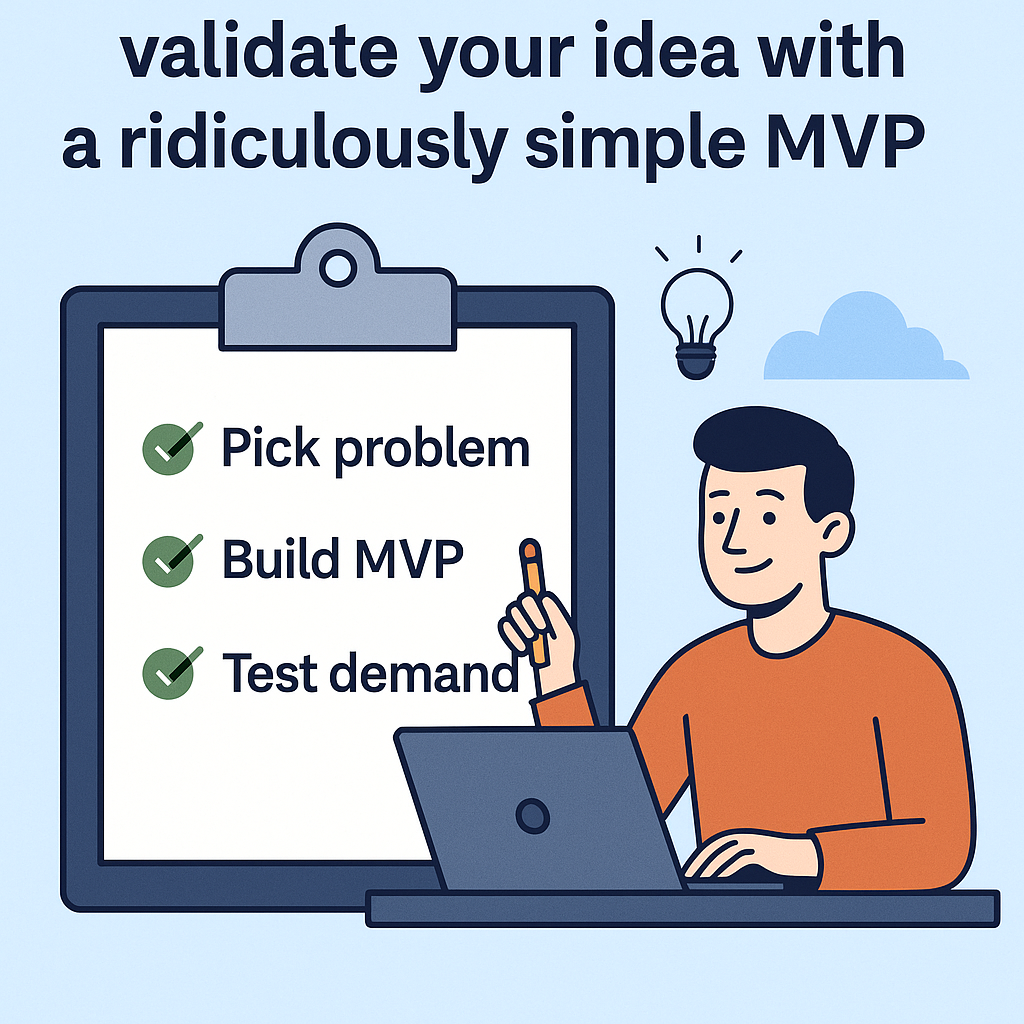
When I first jumped into AI businesses, I made the classic mistake: building something big before anyone proved they’d pay for it. Now I always begin with a simple MVP to test demand in the real world. In practice that means I stitch together ChatGPT for brains, Zapier or Make for glue, and a couple of lightweight APIs to fake the “product” while I learn. If 3–5 strangers won’t pull out a card for the rough version, the slick version won’t save it.
Here’s my 7–30 day validation framework:
Day 1–2 — Problem selection (and promises):
Pick a headache with money behind it. I like repetitive, measurable, boring tasks. Write down a one-sentence promise: “Cut social post creation time by 70%” or “Generate 10 keyword-ready article briefs in 10 minutes.” If I can’t express it that crisply, it’s not ready.
Day 3–5 — Clickable demo or workflow mock:
I wire a quick flow with ChatGPT + Zapier/Make. Inputs in Google Sheets or Airtable, outputs in a doc/Slack/Email. No logins, no billing, no UI beyond what’s necessary to prove the value. I let the “human-in-the-loop” (me or the client) handle edge cases.
Day 6–10 — Paid pilots:
I pitch small businesses (US market tends to have more demand and higher ticket sizes in my experience) and offer a paid 7–14 day pilot. Even $50–$200 matters—free trials hide intent. I keep it time-boxed and outcome-based.
Day 11–20 — Tighten the loop:
Instrument the workflow: how many minutes saved, pieces generated, errors avoided. Add a tiny dashboard (even a spreadsheet) showing before/after. If results are lumpy, insert a simple approval step (Slack button, form) so the user trusts the system.
Day 21–30 — Package and price:
If pilots work, I turn the workflow into a micro-SaaS or productized service. I prefer seat-based pricing for collaboration products, usage-based when compute varies a lot, and outcome-based if the value is crystal clear. My rule: price so that the buyer can justify it with one measurable win per month.
My minimal stack (copy this):
- ChatGPT by OpenAI for ideation, copy, and quick automations.
- Zapier / Make to orchestrate steps.
- API scripts for repetitive tasks (scraping, formatting, enrichment).
- Optional: Airtable/Notion as the “UI” while you validate.
In my case, with just 1–2 free hours per day, this approach consistently lets me ship and test without becoming the bottleneck.
The 12 models that scale with limited founder time
Below are 12 AI business ideas I’ve tested or seen work repeatedly. I cluster them by how I’d package them with minimal overhead.
Micro-SaaS (niche, B2B)
- AI SEO Brief Generator for niche sites
Turns a keyword list into outlines, internal link suggestions, and image prompts. I built an early version for my own sites; it paid for itself in weeks. - Contract Clause Summarizer for freelancers/SMBs
Upload a contract → get decoded risks, deliverables, and dates. Add a “send reminder to calendar” button. - E-commerce Attribute Enricher
Feed product titles → get bullet-proof attributes (color, material, fit) and SEO titles/meta. Priceless for long-tail catalogs. - Meeting Note Compressor for Agencies
From raw transcripts to client-ready bullets, tasks, and the one-sentence “so what.” Add a client portal later if demand is strong.
Automations for small businesses (service → productized)
- Lead Research & Personalization Engine
Scrape, enrich, and draft tailored cold emails. Keep a human approval step. Charge per lead batch. - Accounts Payable Inbox Triage
Pull invoices from email, extract amounts/dates, push to bookkeeping, and ping Slack for approval. - Social Content Conveyor Belt
Given a blog or podcast feed, auto-generate weekly carousels, shorts, and captions. I’ve offered this as a fast audit + setup with steady retainers. - Customer Support Macro Builder
Mine past tickets to generate canonical answers and dynamic macros. Start as a one-off, then upsell updates quarterly.
Content + Audience (own media)
- Programmatic Topical Hubs (quality, not spam)
Generate expert-level outlines, then polish by hand. Monetize with AdSense or digital kits. I’ve leaned on this for steady organic traffic. - Niche Newsletter with AI-assisted Reports
Weekly teardown of a niche (e.g., logistics routing optimizations). Sell sponsorships or a paid tier.
AI-powered services (agency style, outcome-based)
- Productivity Fast Audit
Two-week sprint to map repetitive processes and implement 2–3 automations. I used this format to test demand quickly. - UGC/Creative Variant Generator
Generate and A/B test ad variants + thumbnails (I’ve used Midjourney/DALL·E for image ideation). Sell the testing loop, not just the media.
Why these work with limited time: they’re scoped, measurable, and amenable to human-in-the-loop approvals. In my experience, the sweet spot is “small surface area, obvious ROI.”
How to price and package (seat vs. usage vs. outcome)
Pricing is part math, part story:
- Seat-based (per user): best for collaboration tools (e.g., meeting notes). Anchors to “how many people benefit.”
- Usage-based (per output/minute/credit): perfect when compute or API calls vary (e.g., attribute enrichment). Put a soft tier with overage for predictability.
- Outcome-based (% or fixed for a result): works when the value is undeniable (e.g., booked calls, invoices processed). Needs clean attribution.
Starter rules I use:
- Anchor to a business unit’s monthly win. If a single saved hour or a single lead justifies the fee, you’re safe.
- Avoid fine-grained meters at the start. Keep it simple: “Starter”, “Pro”, “Team”.
- Bundle setup fees for service-heavy ideas; it filters tire-kickers and funds integration.
US market note: I target the US because demand and average order values are higher. That said, I ship from Spain and keep delivery async—recorded demos, Slack/Email updates, and a tiny knowledge base.
Pitfalls that quietly kill AI projects (and how to dodge them)
- Building too big before paid validation. Been there. Start with a workflow and a promise, not a platform.
- No human-in-the-loop. Users won’t trust automation that can make a public mistake. Add a checkpoint; it increases adoption.
- Founder-time trap. If your service depends on you personally, cap your clients and raise prices—or productize parts fast.
- Data and access issues. Secure tokens, least-privilege access, and explicit scopes. Show a mini security note in proposals.
- Vague ROI. If you can’t measure before/after, it won’t scale. Track minutes saved, errors reduced, or revenue-adjacent metrics.
- Shiny-object churn. New models tempt rewrites. Freeze your stack for 4–8 weeks between upgrades.
MVP playbooks by niche (copy-paste, then adapt)
Playbook 1 — SEO Optimizer for content sites (my use case)
- Promise: “Ship 10 SEO-ready briefs in 60 minutes.”
- MVP: Google Sheet (inputs: topics/URLs) → ChatGPT generates briefs (H2/H3, entities, internal links) → dump to Docs.
- Pilot price: $149–$499 for 10 briefs.
- Upgrade path: add internal link graph and image prompts.
- My note: This has performed best for me because it compounds with organic traffic and product sales.
Playbook 2 — AI Thumbnail & Variant Generator (my use case)
- Promise: “5 thumbnail concepts per video in 10 minutes.”
- MVP: Form collects title + brand cues → ChatGPT drafts copy hooks → Midjourney/DALL·E ideates visuals → human tweaks.
- Pilot price: $99 for 5–10 variants.
- Upgrade path: A/B testing template + results dashboard.
Playbook 3 — Productivity Fast Audit for SMBs (my use case)
- Promise: “Automate 2 repetitive tasks in 14 days.”
- MVP: Loom walkthrough → map steps → Zapier/Make build → Slack approval buttons.
- Pilot price: $500–$1,500 setup + $150–$400/month maintenance.
- Upgrade path: add usage dashboard; convert to micro-SaaS if repeatable.
Quick GTM: 0 → 10 US customers
- Where to fish: founder/operator communities, LinkedIn, niche Slack groups, local chambers, podcasts with operators.
- Offer: a paid pilot with a crisp promise and a deadline.
- Proof: show 1–2 anonymized before/after screenshots; don’t oversell the tech.
- Outbound: 20 tailored emails/day, each with a 1-line “I noticed…” and a Loom demo.
- Inbound: a one-pager landing, Calendly, and a short FAQ.
- Retention: weekly summary by email—inputs processed, time saved, next tweak.
Scale roadmap: from solo to a tiny team
- Codify the playbook: turn your pilot steps into checklists and scripts.
- Hire for the loop: a part-time operator to run approvals and QA.
- Abstract the UI: swap Sheets for a simple web front (keep features minimal).
- Instrument everything: basic analytics, error alerts, and a help center.
- Decide your growth path:
- Product-heavy: double down on SaaS features.
- Service-led: keep productized services with strong margins and upsells.
FAQs (2026)
How do I validate in 48–72 hours?
Ship a working workflow with ChatGPT + Zapier/Make, sell 3 paid pilots, measure a single outcome.
What stack should I start with?
ChatGPT for reasoning/content, Zapier/Make for orchestration, a few APIs, and Airtable/Sheets as the UI.
How do I pick a niche?
Follow money and repetition. If the task happens daily and is measurable, you’re in business.
Seat, usage, or outcome pricing?
Seat for collaboration, usage for variable compute, outcome when impact is undeniable.
How do I avoid becoming the bottleneck?
Human-in-the-loop where it matters, but automate everything else. Hire a part-time operator early.
Bonus: quick idea matrix
| Idea | Difficulty | Margin | Founder Time | Best Pricing |
|---|---|---|---|---|
| SEO Brief Generator | Low | High | Low | Seat/Usage |
| Contract Summarizer | Medium | High | Low | Usage |
| E-com Attribute Enricher | Medium | High | Low | Usage |
| Meeting Note Compressor | Low | Medium | Low | Seat |
| Lead Personalization | Medium | High | Medium | Outcome/Usage |
| AP Inbox Triage | Medium | High | Medium | Outcome |
| Social Content Conveyor | Low | Medium | Medium | Retainer |
| Support Macro Builder | Medium | High | Low | Seat/Quarterly |
| Topical Hubs | Medium | High | Medium | Ads/Products |
| Niche Newsletter | Medium | Medium | Medium | Subs/Sponsorship |
| Productivity Audit | Low | High | Medium | Setup + Retainer |
| UGC/Creative Variants | Low | Medium | Medium | Per Batch |
Conclusion (next 48–72 hours)
- Pick one problem with money behind it.
- Ship a workflow MVP (ChatGPT + Zapier/Make).
- Sell 3 paid pilots and measure a single outcome.
- Package, price, and either productize or keep it as a high-margin service.
When I kept ideas small, validated fast, and targeted the US market, the wins stacked quickly—even with just 1–2 hours a day.